

Humiliation vs Humility: Yeshua’s Subversive Way is a Better Way
The Roman Empire was built on a foundation of power, rank, and humiliation. To keep order across vast territories, Rome relied on a system that shamed the weak and exalted the powerful. Public humiliation was not incidental to the empire’s rule; it was essential. It reminded the conquered that they were subjects, not equals. It reinforced a rigid hierarchy where honor was the currency of power instead of humility.
In the ancient world, honor was life itself. To be publicly shamed was to lose your standing in the community. And for Israel—a subjugated, ethnic, religious minority under Rome—humiliation was a daily reality. Any retaliation would be crushed by imperial force. Submission meant loss of dignity. It seemed there was no way out of the system.
And yet, into this world Yeshua spoke words that were nothing short of revolutionary. He did not tell His disciples to fight humiliation with violence or revenge. Nor did He tell them to accept it passively, as though nothing could change. Instead, He taught a third way—a way that transforms humiliation into humility. A way that exposes injustice without replicating it. A way that unmasks the bully while refusing to become one.
Yeshua’s teaching in the Sermon on the Mount offers three vivid examples of this subversive way, this way of humility. Each one shows how disciples can resist humiliation without perpetuating the cycle of domination. Each demonstrates the courage of kingdom humility.
Turning the Other Cheek
Yeshua begins: “If someone strikes you on the right cheek, turn to him the other also.”
At first glance, this might sound like a call to do nothing in the face of violence. But in a world of honor and shame, the meaning is far deeper. To be struck on the right cheek was not primarily about pain. It was about status. A backhanded slap to the right cheek was the severest public insult—a declaration that you were beneath the one striking you.
Normally, there were two responses: legal recourse or violent reprisal. Both were attempts to regain lost honor. But Yeshua offers another way. By turning the other cheek, you refuse to back down, but you also refuse to retaliate. You stand firm, look the insulter in the eye, and force them to strike you with an open hand—a gesture reserved for equals.
This is not passivity. It is resistance. You are saying: “My dignity is not determined by your hand. My honor comes from my Father.” The insult is exposed for what it is: a system that tries to rank human beings. And in that moment, the empire’s humiliation is turned back on itself.
Giving the Cloak
Next, Yeshua says: “If someone sues you for your tunic, give him your cloak as well.”
In the first century, poor people often owned just two garments: a tunic (the inner shirt) and a cloak (the heavy outer garment that doubled as a blanket at night). Torah law even protected the poor from losing their cloak permanently. To sue someone for their tunic was already abusive.
But Yeshua says: if they want your shirt, hand them your coat too. Picture it: you’re left standing in court nearly naked. In Jewish culture, nakedness was an intolerable shame—not to the one stripped, but to the one who caused it. By giving up both garments, you shock the system. You expose the injustice for all to see.
This kind of humility is not about being a doormat. This is not giving in. This is creative nonviolent resistance. By taking humiliation further than your oppressor intended, you unmask their cruelty. You flip the power dynamic. You suffer, yes, but your suffering shines a light that humiliates the system itself.
Going the Extra Mile
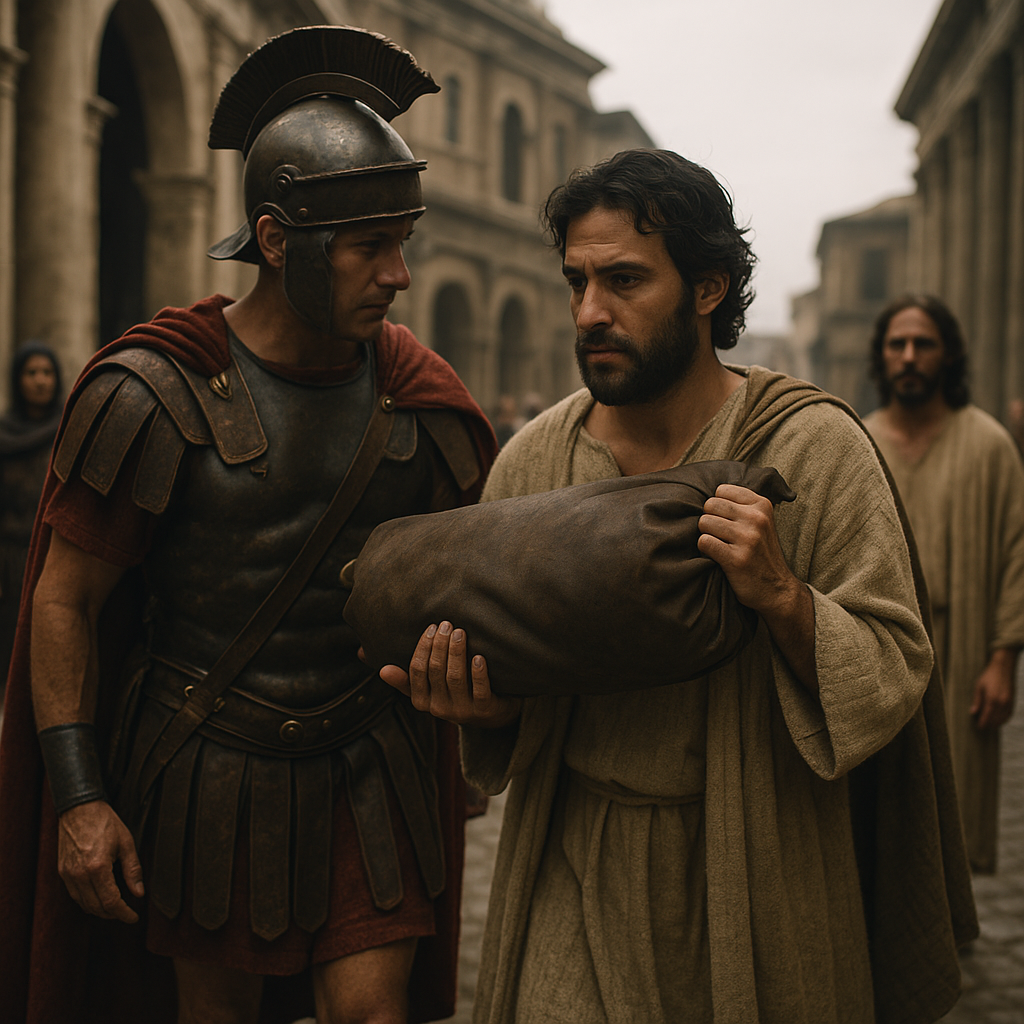
Finally, Yeshua addresses Rome’s most visible symbol of domination: the Roman soldier. Roman law allowed them to compel civilians to carry their military packs for one mile. It was an exercise in humiliation, reducing free men to beasts of burden.
Yeshua says: “If anyone forces you to go one mile, go with him two.”
Imagine the scene. A soldier commands you to carry his load. For the first mile, you are compelled. You are shamed. But at the mile marker, instead of throwing the pack down in bitterness, you keep walking.
Now the soldier is unsettled. His power move is undone. What was humiliation is now transformed into generosity. What was forced servitude is now chosen dignity. In that moment, you redefine the relationship—not by violence, but by humility.
Exposing the System
In each of these examples, Yeshua does more than offer clever advice for surviving humiliation. He exposes the system itself. The Roman world relied on public shame to reinforce its order. But Yeshua’s way of humility reveals the emptiness of that order.
The point is not simply to survive humiliation, but to reveal a different way of operating, a different kingdom. A kingdom where true dignity is found in service and love, not in domination. A kingdom where the powerful cannot ultimately control the weak, because honor comes from God alone.
Humility For Us Today
Yeshua’s words were spoken to people trapped in a specific system—a subjugated minority under imperial rule. But the principles still speak today.
We, too, live in systems that try to rank people by wealth, status, race, or gender. We, too, face situations where humiliation is a weapon. Our instincts are still the same: strike back or shrink away. But Yeshua calls us to another posture: the posture of kingdom humility.
This means choosing forgiveness instead of revenge. It means creative nonviolent responses that expose injustice without perpetuating it. It means remembering that our worth is not determined by cultural systems but by our identity as sons and daughters of God.
And it means realizing that even the perpetrators are trapped. The bully is as bound by the system as the victim. When we respond with humility, we not only resist; we offer the possibility of change.
The Roman Empire sought to humiliate the weak. Yeshua’s kingdom humiliates the system itself. His way unmasks injustice while training His disciples in the courage of humility.
Leave a Reply