

Study Bible Tools: Pattern recognition in Creation
When people study the Bible, they often have trouble seeing the Scriptures as a unifed whole. One of the most important tools is learning to recognize patterns. Biblical pattern recognition means noticing recurring structures, themes, symbols, cycles, and repeated narratives that appear again and again. Instead of treating passages as isolated texts, we need to see how everything connects. Names, numbers, geography, identities, rituals and architectural elements that repeat. These patterns form meaning. They are the Bible’s internal language.
This approach wasn’t invented by modern interpreters. Ancient Near Eastern literature was intentionally layered. Writers used repetition, inversion, mirroring, and numerical sequencing as normal methods for interpretation. Scripture is built this same way. Chiastic structures, creation-shaped story arcs, wordplays, key numbers, and recurring figures reappear as a part of the overall design. Scripture is not built on fragments of text. The Bible is a coordinated story, woven across generations by the biblical writers.
Creation as the Master Pattern
The Bible’s first and most foundational pattern is creation. Creation is not simply the moment the world comes into existence; it is the structure into which the rest of the biblical story fits. Genesis 1–2 serves as the blueprint: God confronts chaos, brings order, forms sacred space, installs His image-bearers, blesses them, and then rests as King. That sequence, moving from disorder to ordered life, becomes the model for everything that follows.
Genesis opens with tohu va-vohu, formlessness and emptiness—the ancient symbol of instability. In the ANE world, the waters of the deep represented ungoverned, unbounded and untamed regions. The Spirit hovering over the darkness is the turning point. The quickening agent to creation. And God does not destroy the deep; He shapes it. His word speaks to disorder and elevates it into a structure that is fruitful and full of life. This is creation as the Bible defines it: God raising up that which is lacking, chaotic, and unformed into an ordered, inhabited sacred space by the power of His Spirit.
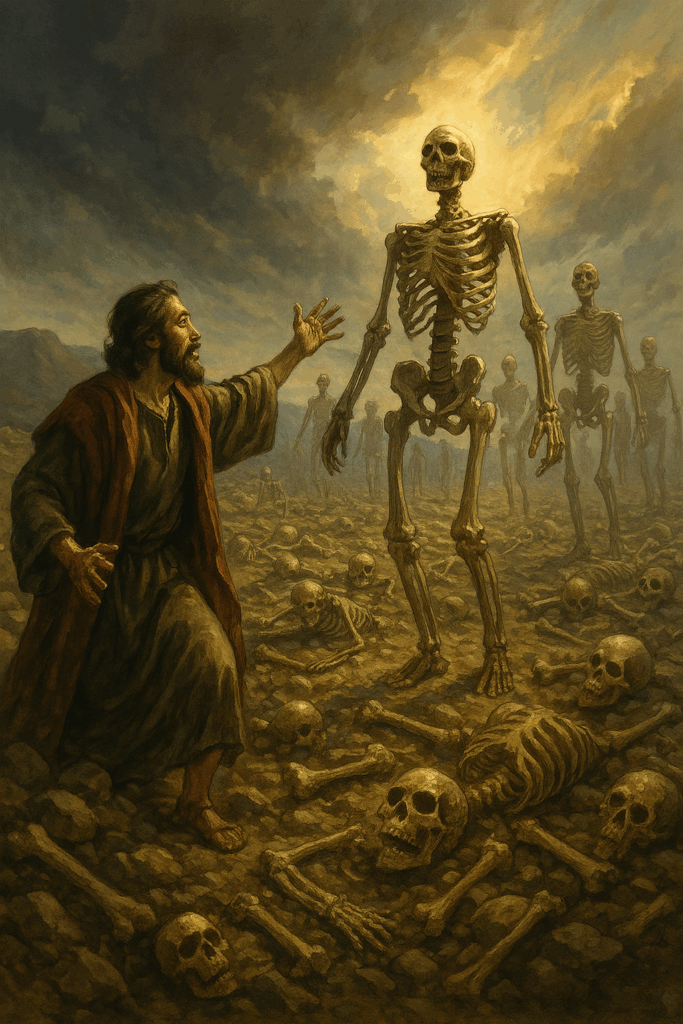
Once you know the pattern, you begin to see it everywhere. Israel trapped at the sea is lifted from danger as the waters divide. Sinai wrapped in cloud, fire, and trembling rock sees the once slave population in Egypt being re-formed into a nation. Ezekiel’s valley of bones, a picture of exile and death, becomes a living people when the prophet speaks breath to dry bones. And the resurrection, the final new creation, raises humanity from mortality into eternal life. Creation is God always forming, filling, and restoring.
Creation as Elevation
The biblical story never treats chaos, collapse, or dysfunction as a permanent state. God repeatedly descends into the broken places in order to lift up His people. Redemption scenes are simply creation scenes being replayed with judgment, rescue, and covenant renewal.
Israel’s history continually illustrates the pattern. The Bible, then, is not a stack of disconnected stories. It is architectural in nature — like a temple with every stone set with intention. Creation is the design that holds it all together.
Creation Patterns Throughout Scripture
The biblical writers deliberately echo Genesis throughout the entire Bible to show continuity. For example, the Exodus story mirrors creation as waters are subdued and a people are formed. The Tabernacle is constructed as Eden-like in miniature. Psalms use creation language to describe divine kingship over the nations. The Gospels announce new creation in Yeshua using the imagery of the garden, breath, and Spirit.
Seeing the creation pattern can help modern readers see the big picture. There’s a single narrative. God elevates, forms, fills, blesses, governs, and rests. That same rhythm underlies the flood, Abraham’s covenant, Israel’s deliverance, the establishment of David’s throne, the incarnation, the cross, and the resurrection. Creation in “pattern recognition” helps us to see God’s elevating work every time He acts.
Ezekiel 37 — A Creation Replay
Ezekiel’s vision of the valley of dry bones is perhaps one of the clearest examples. The scene represents creation in reverse. Israel is in exile. They’ve lost their identity. There’s no central temple, no kingdom, and nothing left to build from. Israel sees itself as “cut off,” like a felled tree that can no longer bear fruit. In ancient symbolism, trees represented kingdoms, so Israel is a kingdom of dead trees.
God asks the key question: “Can these bones live?” From a human perspective, the answer is no. But chaos is always where God begins to work. He instructs Ezekiel to speak, to bring divine breath into the void. Genesis is being deliberately echoed — breath entering dry bones. Bones are reconnected, structure returns and the nation will rise again. Israel is not merely revived; she is re-created.
Ezekiel 37 is a replay of Genesis. From chaos and disorder to the hovering of the Spirit, and a people restored to life for a sacred purpose. It also anticipates the Gospel, where resurrection becomes the final elevation: humanity lifted from death, crowned with glory, and restored to God’s design.
Leave a Reply